Cognitive Development in Children – Toys have long been an essential part of childhood. From simple wooden blocks to complex electronic devices, children have been playing with toys for centuries. However, their value extends beyond entertainment or passing time. Toys play a vital role in the development of a child’s imagination, creativity, and cognitive abilities. When children engage with toys, they are not only having fun but are also developing important life skills that will shape their future.
One type of toy that exemplifies this is the Maisonnette – a miniature house that encourages imaginative play. Additionally, toys such as jeux d’extérieur (outdoor games) offer children opportunities to enhance their physical and cognitive skills while enjoying the outdoors. In this article, we explore how toys help foster imagination and cognitive development in children, unlocking their creativity in the process
Foster Imagination and Cognitive Development in Children

The Role of Imagination in Child Development
Imagination is at the heart of creativity. For young children, the ability to imagine allows them to explore new worlds, understand different perspectives, and express themselves in ways that words alone cannot convey. Imaginative play encourages children to think abstractly, make connections between concepts, and solve problems in novel ways. By engaging in pretend play, children practice their social, emotional, and cognitive skills, developing empathy, communication abilities, and problem-solving strategies.
Toys, especially those designed to stimulate imaginative play, are crucial for this development. For instance, dolls, action figures, building blocks, and even simple props such as toy kitchens or cars enable children to create stories and scenarios, which enhances their creative thinking. Through these activities, children are not only having fun but also constructing mental frameworks that help them understand the world around them.
Maisonnette: A Gateway to Imagination
The Maisonnette, a miniature house or playhouse, is one of the most beloved toys when it comes to stimulating imaginative play. Typically designed with intricate details such as furniture, doors, windows, and even little accessories, these miniature houses provide children with a world of possibilities. Whether they are playing alone or with others, children can create entire stories within the confines of their Maisonnette, acting out scenarios of family life, community events, or adventures.
What makes the Maisonnette particularly effective for fostering imagination is its ability to mimic the real world in a playful, simplified manner. It allows children to assume different roles, from being a parent, a child, a pet owner, or even a neighbour. As children engage with the Maisonnette, they begin to think critically about everyday situations, learn about relationships, and develop social skills. For instance, when playing with others, children must negotiate roles, take turns, and communicate their ideas – skills that are invaluable for social development.
Additionally, the process of setting up and organising the Maisonnette encourages fine motor skills. Arranging furniture, placing items in specific locations, or constructing the playhouse itself involves coordination and attention to detail, which promotes cognitive development. Children also start to develop an understanding of cause and effect – when they push a door, it opens; when they place an item in a certain space, it fits or doesn’t.
Jeux d’Extérieur: Enhancing Cognitive and Physical Growth
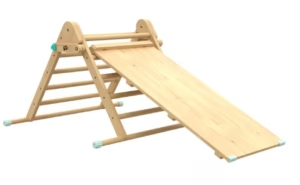
While toys that stimulate imagination indoors are crucial, jeux d’extérieur (outdoor games) provide an equally important opportunity for cognitive and physical growth. Outdoor play encourages children to be more active, fostering physical development, coordination, and strength. But it also contributes to cognitive growth by challenging children to think on their feet, solve problems, and interact with their environment in new ways.
Outdoor toys, such as sports equipment, swings, slides, or even nature-based toys like sandboxes, stimulate a child’s creativity by presenting them with open-ended play opportunities. In the case of jeux d’extérieur, children are often required to engage in group play, where they must work as a team, communicate effectively, and use their problem-solving skills to complete tasks or achieve goals. For instance, a game of tag or hide-and-seek encourages children to think quickly, strategise, and exercise their imagination to come up with different ways of evading or finding others.
Moreover, outdoor play allows children to explore their surroundings. By engaging with nature, they gain a better understanding of the world, learning about plants, animals, and the environment. This sense of exploration fosters curiosity and a deeper appreciation for the world beyond their immediate surroundings. Whether they are running through a park, playing in the garden, or engaging with outdoor toys, children have the chance to engage with their environment in a way that stimulates both their physical and mental faculties.
The Cognitive Benefits of Play
The cognitive benefits of play are well documented. Through play, children learn essential life skills such as problem-solving, planning, and critical thinking. These skills are essential for academic success and are developed in both structured and unstructured play environments. For example, a child building a structure out of blocks may begin by planning the base, considering how to balance the pieces, and figuring out how to create a stable design. This type of play engages spatial awareness, mathematical reasoning, and memory.
In addition to physical development, outdoor games such as jeux d’extérieur encourage teamwork, perseverance, and strategic thinking. By working together in a game, children practice skills such as cooperation, communication, and leadership. The problem-solving aspect of these games, such as figuring out the best way to win or accomplish a task, helps children develop critical thinking skills that will serve them throughout their lives.
Similarly, toys like Maisonnette promote imaginative problem-solving. A child may need to figure out how to arrange the furniture within the small space, decide where certain items should go, or plan out a storyline involving the characters. This type of play fosters both logic and creativity, helping to create a well-rounded thinker.
Social and Emotional Development
Toys also have a significant impact on a child’s social and emotional development. Through toys, children learn to express their feelings, understand others, and develop empathy. For instance, role-playing with a Maisonnette allows children to act out different social scenarios, such as helping a sick friend or resolving a conflict. By stepping into the shoes of different characters, children develop a better understanding of emotions, empathy, and social dynamics.
Outdoor play with friends, meanwhile, encourages cooperation and conflict resolution. It provides a space for children to practice sharing, taking turns, and working as a team. Jeux d’extérieur, especially those that involve group activities, help children understand the importance of collaboration, patience, and mutual respect. These skills are critical for emotional development and social interactions throughout life.
Conclusion
Toys are far more than mere entertainment; they are vital tools for fostering imagination, creativity, and cognitive development in children. Whether it is a Maisonnette that encourages imaginative role play or jeux d’extérieur that challenge physical and mental growth, toys provide children with the opportunities they need to grow and thrive. These seemingly simple objects are the building blocks of a child’s development, helping them build the skills and knowledge they need to navigate the world around them.
By engaging with toys, children learn important life skills that will serve them throughout their education and in their future roles as creative, critical thinkers. So, the next time you watch a child playing, remember that they are not just having fun—they are unlocking their creativity and laying the foundation for their future success.

About Debz Louise
Debz Louise is a UK-based lifestyle expert and the founder of several lifestyle blogs. Specialising in everything from interior design and home renovation to body-positive fashion and parenting, Debz brings a wealth of hands-on experience to every guide. Her mission at Stereotude is to simplify the modern world for her readers through expert curation and fiercely honest advice.